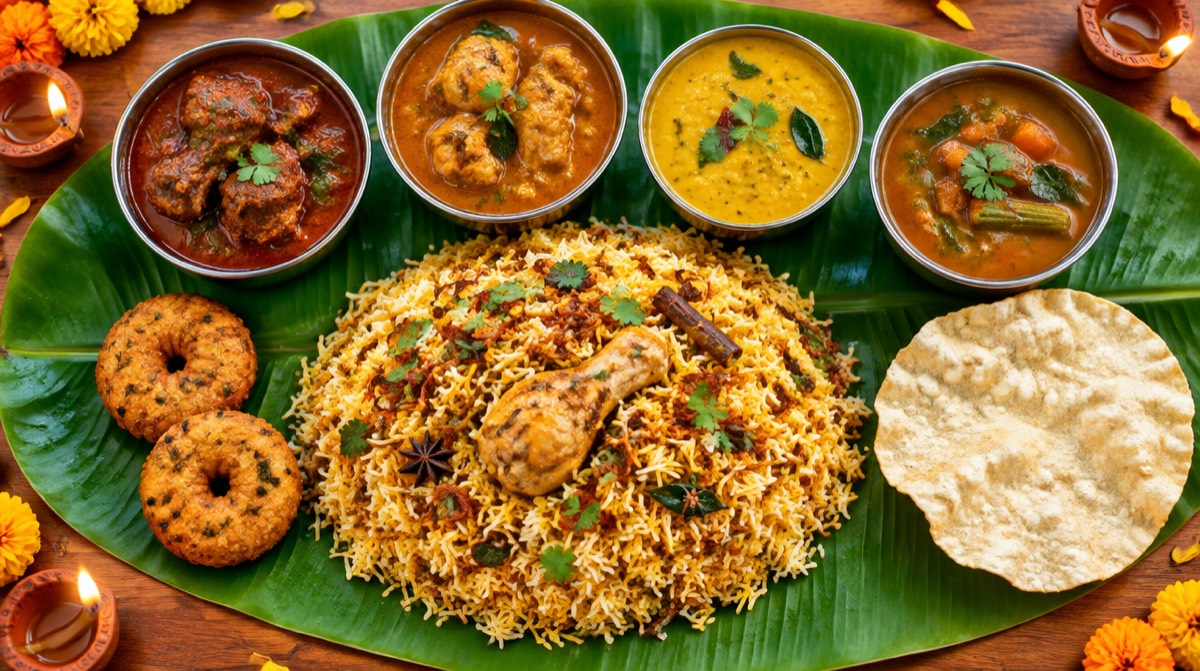
Deepavali Food Calories: Curries, Briyani, Murukku and Sweets, in Grams
One laddu (HPB's 53 g piece) has 216 kcal, 26.5 g carbs and 20.1 g sugar, and one 22 g murukku has 110 kcal and 178 mg sodium, according to HPB Singapore data.
Figures checked against the Health Promotion Board (HPB) Singapore food database on 1 November 2026. Each figure is HPB's per-100 g value x HPB's portion weight x HPB's edible portion.
Deepavali falls on Sunday 8 November 2026. These are the open-house sweets, snacks and plates, each with the grams its figure is based on, so you can match it to what is on your plate.
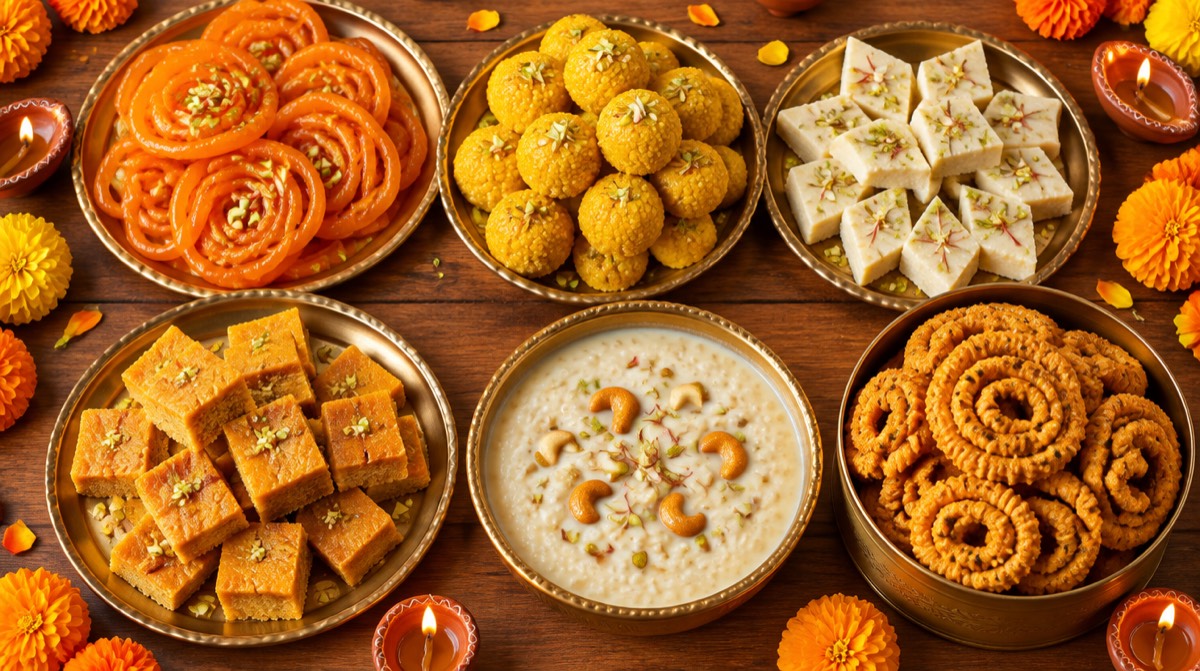
Deepavali sweets, in grams
| Sweet (HPB name) | HPB default portion | Calories | Carbs | Sugar | Sodium | Calories per 100 g |
|---|---|---|---|---|---|---|
| Kueh rose (HPB alias: achu murukku, rose cookies) | 1 piece, 10 g | 50 kcal | 6.2 g | 2.5 g | 13 mg | 496 kcal |
| Rasgula | 1 piece, 30 g | 82 kcal | 16.8 g | 16.8 g | 8 mg | 272 kcal |
| Halwa | 1 piece, 50 g | 173 kcal | 32.5 g | HPB lists none | less than 1 mg | 345 kcal |
| Laddu | 1 piece, 53 g | 216 kcal | 26.5 g | 20.1 g | 11 mg | 407 kcal |
| Athirasam | 1 piece, 55 g | 238 kcal | 36.1 g | 20.2 g | 35 mg | 433 kcal |
| Mysore pak | 1 piece, 44 g | 250 kcal | 26.0 g | 17.2 g | 1 mg | 569 kcal |
| Gulab jamun | 1 piece with syrup, 83 g | 257 kcal | 44.6 g | 36.5 g | 32 mg | 310 kcal |
| Kesari | 1 plate, 107 g | 261 kcal | 43.7 g | 16.6 g | 25 mg | 244 kcal |
| Barfi | 1 piece, 50 g | 271 kcal | 27.5 g | 22.0 g | 6 mg | 541 kcal |
| Sohn papdi (HPB alias: soan papdi) | 1 piece, 53 g | 281 kcal | 34.5 g | 24.6 g | 2 mg | 530 kcal |
| Chocolate burfi | 1 piece, 63 g | 299 kcal | 39.1 g | 26.3 g | 42 mg | 474 kcal |
| Rice kheer (HPB alias: payasam) | 1 bowl, 218 g | 353 kcal | 42.9 g | 15.5 g | 137 mg | 162 kcal |
| Jalebi | 1 piece, 114 g | 359 kcal | 65.3 g | 31.5 g | 50 mg | 315 kcal |
| Suji halwa | 1 plate, 133 g | 378 kcal | 56.9 g | 36.3 g | 39 mg | 284 kcal |
| Rasmalai | 1 piece, 252 g | 451 kcal | 64.5 g | 57.0 g | 131 mg | 179 kcal |
HPB's rasmalai portion is 252 g, including the milk it is served in. HPB lists no sugar figure for halwa, and lists 0.01 mg sodium per 100 g, which is less than 1 mg for the 50 g piece.
Murukku and savoury snacks
| Snack (HPB name) | HPB default portion | Calories | Carbs | Sugar | Sodium | Calories per 100 g |
|---|---|---|---|---|---|---|
| Muruku (murukku) | 1 piece, 22 g | 110 kcal | 10.2 g | 0.5 g | 178 mg | 500 kcal |
| Vadai with kacang hitam | 1 piece, 60 g | 131 kcal | 10.5 g | 0.4 g | 391 mg | 219 kcal |
| Samosa | 1 piece, 42 g | 144 kcal | 17.4 g | 1.4 g | 225 mg | 343 kcal |
| Vadai | 1 piece, 60 g | 168 kcal | 15.1 g | 0.8 g | 368 mg | 280 kcal |
Curries and rice
| Dish (HPB name) | HPB default portion | Calories | Carbs | Sodium | Calories per 100 g |
|---|---|---|---|---|---|
| Nasi briyani (chicken) | 1 plate, 759 g | 1,100 kcal | 112.9 g | 2,783 mg | 155 kcal |
| Nasi briyani (mutton) | 1 plate, 724 g | 1,211 kcal | 132.5 g | 3,077 mg | 181 kcal |
| Nasi briyani (fish or prawn) | 1 plate, 587 g | 863 kcal | 103.0 g | 2,448 mg | 147 kcal |
| Nasi briyani (vegetable) | 1 plate, 518 g | 668 kcal | 99.1 g | 1,756 mg | 129 kcal |
| Mutton curry | 1 scoop, 302 g | 559 kcal | 5.5 g | 1,383 mg | 185 kcal |
| Chicken curry | 1 bowl, 347 g | 489 kcal | 8.2 g | 1,223 mg | 146 kcal |
| Fish head curry | 1 scoop, 100 g | 147 kcal | 6.5 g | 334 mg | 150 kcal |
| Dhal curry | 1 scoop, 100 g | 101 kcal | 10.3 g | 375 mg | 101 kcal |
| Sambar | 1 bowl, 339 g | 241 kcal | 26.6 g | 1,668 mg | 71 kcal |
| Thosai | 1 piece, 156 g | 402 kcal | 63.9 g | 501 mg | 258 kcal |
Plates with bones (chicken and mutton briyani, chicken curry, fish head curry) count only the edible part, the same way HPB does, and their per-100 g figure is per 100 g of the edible part.
Drinks
| Drink (HPB name) | HPB default portion | Calories | Carbs | Sugar | Sodium | Calories per 100 g |
|---|---|---|---|---|---|---|
| Teh halia (HPB alias: ginger tea) | 1 regular cup, 250 g | 145 kcal | 27.5 g | 25.2 g | HPB lists none | 58 kcal |
| Lassi | 1 medium cup, 250 g | 175 kcal | 26.4 g | 21.6 g | HPB lists none | 70 kcal |
| Iced teh halia | 1 regular cup, 400 g | 180 kcal | 34.1 g | 31.2 g | HPB lists none | 45 kcal |
Per piece vs per 100 g
HPB's pieces differ in weight, so the per-100 g column is there to rescale to the grams on your plate. Mysore pak is 569 kcal per 100 g, and HPB's 44 g piece is 250 kcal. Jalebi is 315 kcal per 100 g, and HPB's 114 g piece is 359 kcal.
NutriKaki never confirms a dish is halal or vegetarian. Ask your host or the stall.
Frequently Asked Questions
HPB lists one laddu (53 g piece) at 216 kcal, with 26.5 g carbs, 20.1 g sugar and 11 mg sodium.
HPB's murukku piece is 22 g and has 110 kcal, 10.2 g carbs and 178 mg sodium. Per 100 g it is 500 kcal and 811 mg sodium.
HPB's jalebi piece is 114 g and has 359 kcal, 65.3 g carbs and 31.5 g sugar.
One gulab jamun with syrup (HPB's 83 g piece) has 257 kcal, 44.6 g carbs and 36.5 g sugar.
Of the 15 sweets in the sweets table, rasmalai has the most per HPB portion: 451 kcal for a 252 g piece, which includes the milk it is served in. Next are suji halwa at 378 kcal for a 133 g plate and jalebi at 359 kcal for a 114 g piece. Per 100 g, mysore pak has the most of the 15 sweets, at 569 kcal, and rasmalai has 179 kcal.
HPB's default plate of chicken briyani is 759 g and works out to 1,100 kcal, counting only the edible part (the bones are left out). Change the grams in NutriKaki to match your plate.
Nutrition data sourced from the Health Promotion Board (HPB) Singapore food composition database. Every per-piece, per-plate, per-bowl, per-scoop and per-cup figure in this article was computed as HPB's per-100g value multiplied by HPB's own recorded default portion weight and edible portion percentage. Per-100g values are HPB's directly. Values vary by stall, recipe and portion, so check the gram weight before applying a per-portion figure to what is in front of you. This article is for general information only and does not constitute medical or dietary advice. Nutrition data referenced in this article is used under licence from the Health Promotion Board (HPB) of Singapore and may not be redistributed, republished, or reused commercially without NutriKaki's prior written permission.