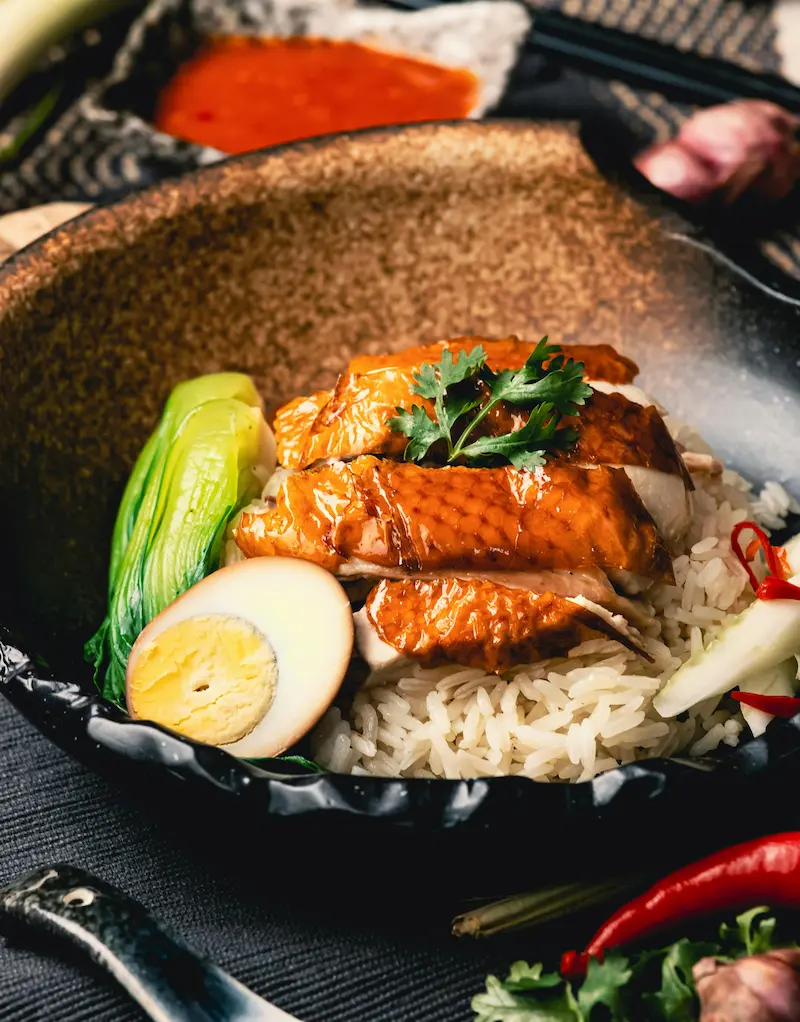
Chicken Rice Calories: Steamed vs Roasted — The Full Breakdown
One plate of steamed chicken rice (346 g) has 488 kcal; roasted chicken rice (363 g) has 643 kcal. Data: HPB Singapore food composition database.
Chicken Rice Calories per Plate (HPB Singapore)
| Dish and portion | Calories | Protein | Fat | Carbs | Sodium |
|---|---|---|---|---|---|
| Steamed chicken rice, 1 plate (346 g) | 488 kcal | 19.2 g | 11.6 g | 75.7 g | 1,227 mg |
| Roasted chicken rice, 1 plate (363 g) | 643 kcal | 29.7 g | 20.9 g | 84.1 g | 1,061 mg |
| Soya sauce chicken rice, 1 plate (310 g) | 471 kcal | 24.8 g | 6.9 g | 79.0 g | 605 mg |
| Steamed chicken rice, rice only, 1 plate (220 g) | 387 kcal | 7.5 g | 7.8 g | 71.6 g | 847 mg |
| Claypot chicken rice, 1 bowl (543 g) | 974 kcal | 65.7 g | 27.9 g | 114.4 g | 2,474 mg |
| Chicken baked rice, 1 plate (389 g) | 731 kcal | 32.9 g | 30.7 g | 80.7 g | 1,350 mg |
Food data: HPB Singapore. Each row is HPB's figure for the whole dish at the gram portion shown. Real plates vary by stall. NutriKaki shows the gram portion for each plate and lets you change it.
Why the Rice Matters
Rice is most of the plate by weight and energy. The rice alone, without chicken, comes to 387 kcal for a 220 g plate in HPB's data, which is most of the 488 kcal in a 346 g plate of steamed chicken rice. Chicken rice is cooked in chicken stock and sometimes chicken fat, so the rice carries real energy before any chicken is added.
Asking for "siu fan" (less rice) reduces the rice portion, and with it the energy and carbohydrate on the plate.
Steamed vs Roasted: What's Different?
Steamed chicken rice
The chicken is poached in stock. In HPB's data, a 346 g plate has 11.6 g fat and 19.2 g protein.
Roasted chicken rice
Roasting with soy sauce, sesame oil and spices adds flavour and fat. In HPB's data, a 363 g plate has 20.9 g fat and 29.7 g protein, and the energy is higher at 643 kcal.
Ordering Tips
Frequently Asked Questions
One plate of steamed chicken rice (346 g) has 488 kcal and one plate of roasted chicken rice (363 g) has 643 kcal, per the HPB Singapore food composition database.
Steamed chicken rice has 488 kcal for a 346 g plate, with 11.6 g fat. Roasted chicken rice has 643 kcal for a 363 g plate, with 20.9 g fat (HPB Singapore).
HPB lists rice only from steamed chicken rice at 387 kcal for a 220 g plate.
Siu fan means less rice in Cantonese. Rice is most of the plate by weight and energy, so asking for less rice changes the plate the most.
HPB lists 19.2 g protein in a 346 g plate of steamed chicken rice and 29.7 g in a 363 g plate of roasted chicken rice.
Nutrition data sourced from the Health Promotion Board (HPB) Singapore food composition database. All figures are HPB whole-dish values at the gram portion shown. Values are approximate and vary by stall, portion, and cooking method. This article is for general information only and does not constitute medical or dietary advice. Nutrition data referenced in this article is used under licence from the Health Promotion Board (HPB) of Singapore and may not be redistributed, republished, or reused commercially without NutriKaki's prior written permission.