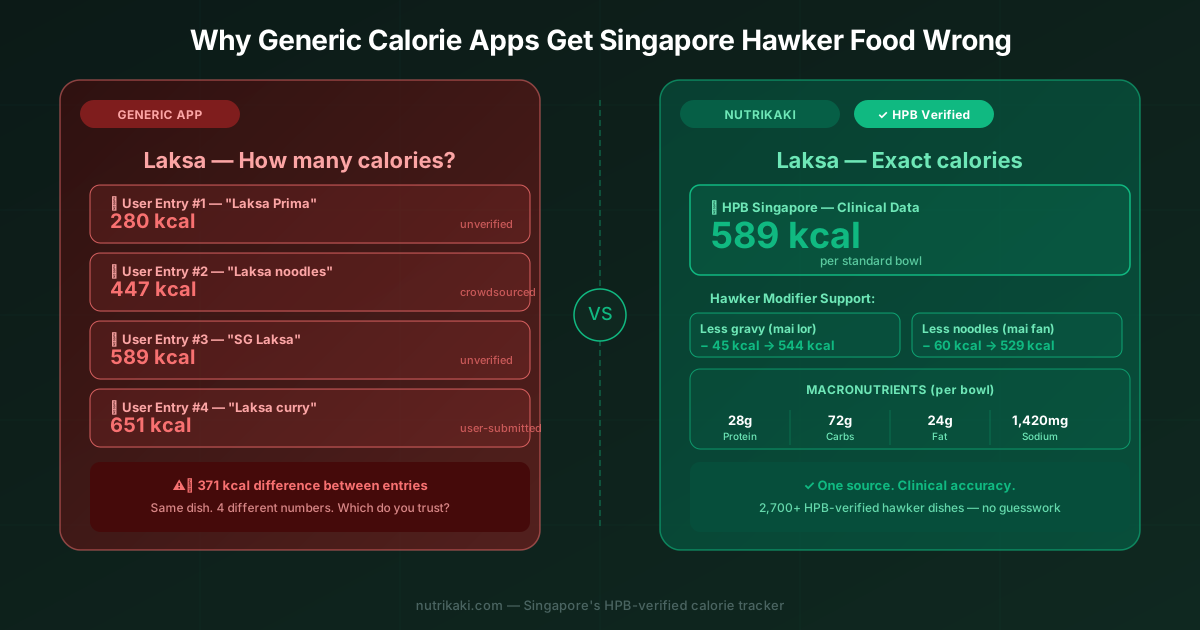
Why One Hawker Dish Can Show Many Calorie Numbers
You've been diligently tracking your meals. You logged your laksa. You hit your calorie target. You feel good. But there's a problem: the number you logged may be off by 200, 300, or even 400 calories — and you'd never know.
This is the core issue with using generic international calorie apps to track Singapore hawker food. The apps weren't built for your food. The data wasn't collected from your stalls. And the gap between what they show and what you actually ate can quietly sabotage months of effort.
This post looks at why one dish can show many numbers, and what HPB data looks like.
Problem #1: Crowdsourced Data Can Be Inconsistent
Generic calorie apps are built on a simple model: users submit the foods they eat, and those submissions form the database. This works reasonably well for packaged foods with nutrition labels. It falls apart completely for fresh hawker food.
Here is an example of how one dish can appear across user-submitted entries:
| User-Submitted Entry | Calories Shown | Source |
|---|---|---|
| Laksa Prima | 280 kcal | User-submitted |
| Laksa noodles | 447 kcal | User-submitted, crowdsourced |
| SG Laksa | 589 kcal | User-submitted (HPB's figure is 429 kcal — see below) |
| Laksa curry noodle | 651 kcal | User-submitted, crowdsourced |
The same dish. Four different numbers. A 371 kcal spread. Which one do you pick? There's no way to know which is closer to the truth — because none of them point to a source. They are entries from different users, stalls and days.
The inconsistency compounds across every meal. If you're off by 200 kcal at lunch and 150 kcal at dinner, that's 350 kcal per day — or roughly 2,450 kcal per week of invisible difference. You could be gaining weight on a "calorie deficit" that was never actually a deficit.
Problem #2: No Understanding of Hawker Ordering Language
When you order at a kopitiam or hawker centre, you speak in modifiers. Siew dai. Kosong. Mai fan. Mai lor. Gah dai. Less rice. No chilli. These aren't just preferences — they change the nutritional content of your meal significantly.
Many international apps were built for Western food environments where a "coffee" is a coffee and a "sandwich" is a sandwich, so they may not have fields for hawker-specific ordering instructions.
If you order a kopi C siew dai every morning and log it as a regular kopi C, you're overcounting by around 18 kcal — roughly 126 kcal per week, 6,550 kcal per year. That's still nearly a kilogram of calculated weight loss that never actually existed in your data.
NutriKaki understands these modifiers natively. When you say "less rice" or "no gravy", the calorie and macro counts adjust in real time based on HPB portion data.
Problem #3: Missing Entire Dish Categories and Variants
Singapore hawker food is not one dish — it's a system of infinite customisation. A plate of cai png (economy rice) can be assembled in thousands of combinations. Char kway teow has a wet version and a dry version with meaningfully different calorie counts. Bak chor mee soup is not the same as bak chor mee dry. Yong tau foo calorie count depends entirely on which items you choose and whether it's in soup or dry.
In a user-submitted database, a dish may have only one or two entries, each from someone who ate one version at one stall. That is hard to match to the variety of hawker food.
NutriKaki's HPB database covers the variants — dry vs soup, standard vs less rice, steamed vs roasted, with and without specific toppings — because HPB measured them as separate entries with real nutritional analysis.
Problem #4: Western Portion Size Assumptions
Western-focused calorie apps may use different portion sizes as their reference. A Singapore bowl of mee siam or prawn mee is typically 400–500g with broth. A cai png plate portion for rice alone is calibrated differently from a generic "white rice, 1 cup" entry.
These portion mismatches are easy to miss when you log a meal.
HPB measured Singapore hawker food as it is actually served at Singapore hawker stalls — standard portions purchased the same way you would buy them.
Problem #5: Purine Is Rarely Shown
Some hawker staples, such as organ meats, seafood broths, bean curd and certain leafy vegetables, are high in purine. If you track purine, it matters as much as calories.
Most calorie apps show calories and macronutrients. NutriKaki also shows purine for each dish if you track it.
NutriKaki flags high-purine meals like pig organ soup, crab bee hoon, and certain fish broths. The high-purine warning is free; the daily total is part of Pro. Unlike the calorie and macro figures, purine values do not come from HPB, which does not publish purine data; they are estimated from published nutrition research and each carries a confidence level. NutriKaki is a tracking tool, not medical advice. Talk to your doctor about your condition.
What HPB Data Actually Means
How HPB Collects Its Data
The Health Promotion Board (HPB) is Singapore's national health authority. Their nutritional database is not crowdsourced — it is built from laboratory analysis of actual hawker food purchased from actual Singapore stalls.
- Dishes are purchased from hawker centres across Singapore
- Nutritional content is measured in a laboratory
- Multiple samples are tested to account for stall-to-stall variation
- Macros, sodium, sugar, and micronutrients are all measured — not estimated
- Results reflect Singapore hawker portions
When NutriKaki shows you 429 kcal for laksa, that number comes from HPB's laboratory measurement of laksa purchased from Singapore hawker stalls.
This matters when you use calorie data for everyday decisions: whether to have a second piece of roti prata, or whether today's hawker lunch fits your target.
Frequently Asked Questions
Why can one dish show different calories in different apps?
When a database is built from user submissions, the same dish — like laksa or chicken rice — can have many entries from different users, stalls and portions, with different calorie counts. For local dishes, NutriKaki uses the HPB Singapore database and shows the gram portion with the calories.
What is HPB data and why does it matter?
HPB stands for the Health Promotion Board, Singapore's national health authority. HPB conducts laboratory analysis of actual Singapore hawker dishes purchased from local stalls and measures their nutritional content in a laboratory. This means calorie, protein, carbohydrate, fat, sodium, and sugar values are based on measurements of those samples.
Can I use an international calorie app to track Singapore hawker food?
International apps were built for Western food environments with standardised ingredients and portions. Singapore hawker food has enormous variation — a plate of char kway teow from one stall can have twice the oil of another. Ordering modifiers like siew dai, kosong or mai fan can shift calories by 50 to 150 kcal per meal, so it helps to use a tracker that handles them.
What does "siew dai" mean for calories?
Siew dai means less sugar in Hokkien, commonly used when ordering kopi or teh. A kopi with full sugar is around 100 kcal; a kopi siew dai is around 55–65 kcal — a meaningful daily difference. NutriKaki understands siew dai, kosong, gah dai, and other local modifiers, adjusting calorie and sugar counts automatically.
What is NutriKaki built on?
NutriKaki is a calorie tracker built on HPB Singapore data for hawker food. It supports hawker ordering modifiers and shows purine per dish if you track it. A tracking tool, not medical advice. Talk to your doctor about your condition.
Calorie figures cited in this article are sourced from the Health Promotion Board (HPB) Singapore nutritional database. Individual values may vary based on stall preparation, portion size, and specific ingredients used. NutriKaki data is for general informational purposes and should not replace professional dietary advice. Nutrition data referenced in this article is used under licence from the Health Promotion Board (HPB) of Singapore and may not be redistributed, republished, or reused commercially without NutriKaki's prior written permission.