Hokkien Mee Calories Singapore: Better Than You Think?
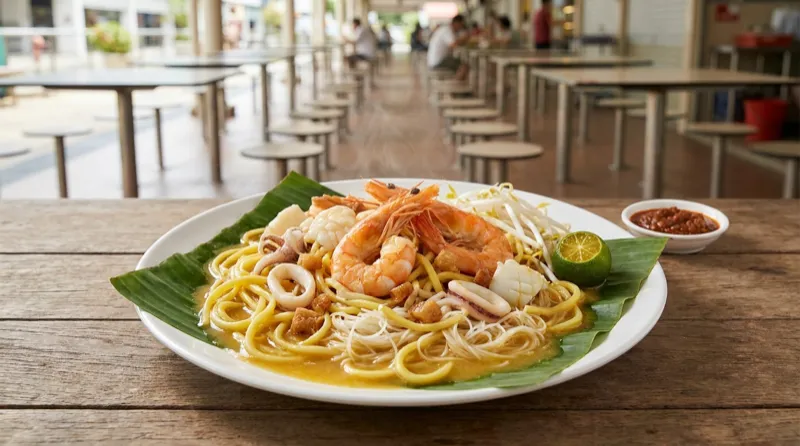
Singapore Fried Hokkien Prawn Mee — thick yellow noodles and rice vermicelli tossed in a rich prawn stock, served with lard, sambal chilli, and a squeeze of lime — is one of the most iconic dishes you'll find at any hawker centre. From the legendary stalls at Old Airport Road to your neighbourhood coffee shop, this dish is a Singaporean staple.
Many people assume it belongs in the same "avoid if you're watching your weight" category as char kway teow. The reality is more encouraging. According to HPB Singapore’s official portion data, a standard 549g plate of Hokkien Mee comes in at 830 calories — somewhat lower than a plate of char kway teow at 989 calories (HPB’s official 480g plate), and with a better protein profile thanks to the seafood base.
That doesn't mean it's without concern. The sodium content alone — around 1,938mg per serving — is something to take seriously. Here's the full breakdown.
Hokkien Mee Calories: The HPB Numbers
The following data is sourced from the Health Promotion Board (HPB) Singapore food composition database, measured for HPB's official 549g plate of Fried Hokkien Prawn Mee.
| Nutrient | Amount per serving (549g) |
|---|---|
| Calories | 830 kcal |
| Protein | 29.5g |
| Total Fat | 43.4g |
| Saturated Fat | ~16.5g (est.) |
| Carbohydrates | 79.4g |
| Dietary Fibre | ~5.5g (est.) |
| Cholesterol | ~165mg (est.) |
| Sodium | 1,938mg |
How Does It Compare Across Portion Sizes and Stalls?
The 830-calorie figure is HPB’s official 549g plate — the only row below that is directly measured by HPB. In practice, calories can vary meaningfully depending on portion and preparation; the other rows are estimates built on top of that HPB baseline, not separate HPB entries:
| Variant | Calories | Key Difference |
|---|---|---|
| Small portion, no lard, extra bean sprouts | ~400–440 kcal (estimate) | Lighter oil, smaller noodle base |
| Standard (HPB reference, no lard) | 830 kcal | Vegetable oil instead of lard — HPB's measured plate |
| Standard with lard (traditional) | ~870–910 kcal (estimate) | +40–80 kcal from pork fat, on top of HPB's 830 kcal baseline |
| Large portion with lard | ~950–1,050 kcal (estimate) | Bigger noodle base + extra oil, on top of the lard baseline |
| Large with lard + full sambal + sugary drink | ~1,050–1,250 kcal (estimate) | Drink alone adds 100–200 kcal |
What's Inside a Plate of Hokkien Mee?
Understanding the ingredients helps you make smarter substitutions. Here's what goes into a standard plate and where the calories and sodium are hiding:
| Ingredient | Approx. Calories | Main Concern |
|---|---|---|
| Yellow noodles (~100g) | ~130–150 kcal | High GI carbs |
| Thick rice vermicelli (~50g) | ~65–80 kcal | Lower than yellow noodles |
| Prawn stock sauce (2–3 tbsp) | ~30–50 kcal | Main sodium source |
| Prawns (~50g, 3–4 pieces) | ~45–60 kcal | Good lean protein |
| Cuttlefish / squid (~30g) | ~25–35 kcal | Good lean protein |
| Pork belly (~30g) | ~70–90 kcal | Saturated fat |
| Egg (1 large) | ~70–80 kcal | Protein + fat |
| Lard (1–2 tbsp, if used) | ~115–230 kcal | Saturated fat |
| Bean sprouts + chives | ~10–15 kcal | Fibre, negligible calories |
| Sambal chilli (1 tbsp) | ~15–25 kcal | Sodium + sugar |
The lard question
Traditional Hokkien Mee stalls use rendered lard for that deeply savoury, smoky finish. At around 115 calories per tablespoon, even one tablespoon adds a noticeable chunk. Newer stalls, or those with the HPB Healthier Choice Symbol, typically use vegetable oil — shaving 115 to 230 calories off the dish without dramatically changing the flavour for most people.
The noodle ratio matters
Hokkien Mee is unique in that it mixes two types of noodle: thick yellow wheat noodles and thicker white rice vermicelli (bee hoon). Yellow noodles are slightly more calorie-dense. If you want to lighten the meal, ask for more bee hoon and less yellow mee — it makes a modest but meaningful difference.
The Sodium Problem
At 1,938mg of sodium, a standard plate of Hokkien Mee accounts for nearly 97% of the HPB's recommended daily maximum of 2,000mg. The sodium comes primarily from the prawn stock used as the base sauce, plus the sambal chilli, soy sauce, and lard (which is often seasoned). This is the single biggest nutritional concern with the dish — not the calories.
Hokkien Mee vs Other Hawker Dishes
| Dish | Approx. Calories | Verdict |
|---|---|---|
| Chicken Rice (steamed, standard plate) | ~523 kcal (HPB’s 346g plate) | ✅ Best choice |
| Fish Soup (clear broth, sliced fish) | ~280–360 kcal | ✅ Excellent |
| Hokkien Mee (standard, no lard) | ~830 kcal | ✅ Better than its rep |
| Economy Rice (3 items, 1 meat) | ~480–580 kcal | 👍 Depends on choices |
| Roti Prata (2 plain) | ~400–480 kcal | 👍 Manageable |
| Hokkien Mee (with lard) | ~560–600 kcal | ⚠️ Moderate |
| Laksa (full bowl) | ~429 kcal | ⚠️ High sodium + fat |
| Nasi Lemak (full set, chicken wing) | 831 kcal | ⚠️ Heavy |
| Char Kway Teow (standard) | 989 kcal | ❌ Occasional treat only |
How to Order Hokkien Mee Smarter
Singapore vs Malaysian Hokkien Mee: A Calorie Note
Worth clarifying for visitors or anyone who's tasted both: Singapore Hokkien Mee and Malaysian Hokkien Mee (particularly the KL or Penang style) are quite different dishes.
Singapore Hokkien Mee is a wet or semi-dry prawn-based stir-fry with a light, fragrant stock. KL-style Hokkien Mee is much darker — cooked with thick dark soy sauce and significantly more lard, closer in character to char kway teow. The calorie and fat profile of KL Hokkien Mee is likely higher still. HPB’s 830-calorie figure applies specifically to the Singapore-style version.
Frequently Asked Questions
A standard plate of Singapore Fried Hokkien Prawn Mee, per HPB’s official 549g plate portion, contains 830 calories. This includes 29.5g of protein, 43.4g of fat, and 79.4g of carbohydrates.
Hokkien Mee (830 kcal) is somewhat lower than char kway teow (989 kcal per HPB’s official plate), though both are heavier dishes. Hokkien Mee also provides more protein from the seafood base and typically uses less lard per serving.
A standard plate contains approximately 1,938mg of sodium — mostly from the prawn stock, soy sauce, and sambal chilli on the side. The HPB recommends a daily maximum of 2,000mg for adults, so one plate already uses about 97% of that allowance.
At 830 kcal, a full plate takes up a meaningful share of a 1,500 to 1,800 kcal daily budget. Ask for a smaller portion or share it, skip the lard, go easy on sambal, and pair with plain water rather than a sugary drink. Log it in NutriKaki to stay on track.
Singapore Hokkien Mee is a wet or semi-dry prawn-based stir fry with yellow noodles, thick rice vermicelli, egg, cuttlefish, and sambal on the side. Malaysian Hokkien Mee (especially KL-style) is darker, drier, and cooked with more lard and dark soy sauce — typically higher in calories.
Nutrition data for Fried Hokkien Prawn Mee sourced from the Health Promotion Board (HPB) Singapore food composition database (reference serving: 549g). Values for other variants are estimates based on standard ingredient composition and may vary by stall, portion, and preparation method. This article is for general wellness purposes only and does not constitute medical or dietary advice. Nutrition data referenced in this article is used under licence from the Health Promotion Board (HPB) of Singapore and may not be redistributed, republished, or reused commercially without NutriKaki's prior written permission.